
ABCP Secretary General Most Ven. Kh Byambajav together with Venerable Kyokey Ono of the Japan ABCP National Centre, attended an international dialogue “UNITED & PRESENT: CONTEMPLATIVE PRACTICES, COMPASSION AND COLLECTIVE WELL-BEING” convened by the UN Human Rights Office (OHCHR) in cooperation with Bodhigaya Vijjalaya 980 Institute and Dharma Alliance. The gathering was held at Krabi Thailand from 12–14 October 2026.
Around 40 participants from across the world — contemplative tradition-holders, scholars, diplomats, and UN officials — came together for three days of deep and substantive dialogue on the relationship between meditation, human dignity, and collective well-being.
Rev. Kyokey Ono was specially invited by the organisers as they also wanted to learn more about meditation and compassion in Zen Buddhism.
Our Secretary General Most Venerable Kh. Byambajav presented a paper entitled “Compassion, cooperation, social welfare, and trust” and also gave a brief interview with the OHCHR Well-being unit on compassion.
At the meeting we met with Ms. Sabina Lauber, OHCHR Chief of Mission in Bangladesh and Mr. Timothy Paul Wilson, UN resident Coordinator’s Office in Bhutan and spoke with them about our National Centers in Bangladesh and Bhutan, and proposed they meet with our National Centres in both Bangladesh and Bhutan for possible future collaboration.
The United Nations General Assembly has proclaimed December 21 as World Meditation Day to promote physical, mental, and emotional well-being across the globe. This decision was unanimously adopted by the UN General Assembly on December 6, 2024, via a resolution co-sponsored by India, Liechtenstein, and a core group of member states (including Mongolia). It is observed annually on December 21 (coinciding with the winter solstice in many regions, mirroring the International Day of Yoga on June 21). Its purpose is to raise awareness of meditation as a self-care and stress-management tool, foster inner peace, and support mental health in line with World Health Organization (WHO) principles.
The Gathering closed with the adoption of the Krabi Declaration (shared below) which affirms at its heart that the universality of meditation is not a homogeneity — its richness as a global human heritage lies in the plurality of traditions through which it is lived, each carrying its own philosophical, ethical and community understanding.
ABCP Secretary General Most Venerable Kh. Byambajav gave an interview to the Well-Being Unit of the UN High Commissioner for Human Rights on the substance and significance of compassion in Buddhism.
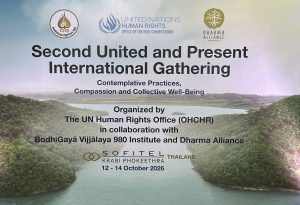
The Krabi International Gathering, Thailand, 12 October 2026
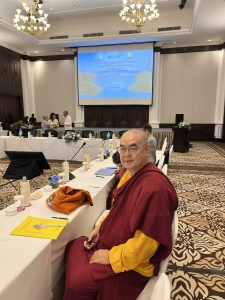
ABCP Secretary General, Most Venerable Kh. Byambajav at the Krabi Meeting
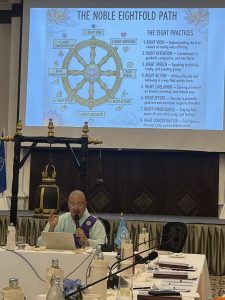
Venerable Kyokey Ono, Japan ABCP National Center during his session on meditation
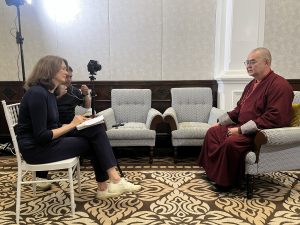
ABCP Secretary General during his interview with Jane Drake, OHCHR Well-being Unit
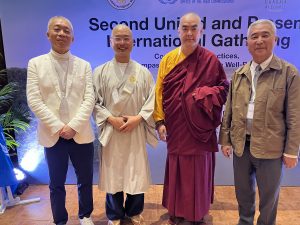
Left to rigjt: Dr. Supachai Verapuchong, Founder and Secretary General of Bodhigaya Viijalaya 980 Institute, Ven. Kpyokey Ono of Japan ABCP National Centre, Most Venerable Kh. Byambajav, Secretary General of ABCP and Burenbayar Chanrav, ABCP Senior Manager at Krabi, Thailand
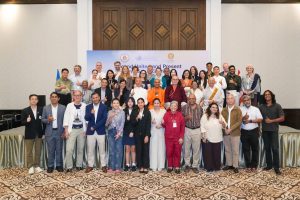
Participants in the international meeting on meditation in Krabi, Thailand